
 Read time 8 min
✓
✓
✓
✓
✓
✓
Can you trust AI to abstract commercial leases? Yes, as a first draft. AI lease abstraction speeds up data extraction, but accuracy varies by document quality and clause complexity, so no tool’s accuracy claim should replace testing on your own leases. Trust AI output only after a person verifies critical dates, rent figures, and key clauses against the source lease.
Introduction
Commercial leases run dozens of pages, and every amendment, renewal, or acquisition adds more. It’s no surprise that AI lease abstraction is one of the first AI use cases CRE teams try. But trying a tool and trusting its output are different things.
Deloitte’s 2027 Commercial Real Estate Outlook, based on a survey of 950 CRE executives and their direct reports across 13 countries, found that 92% of respondents were still in the piloting or research phase, while only 8% had integrated AI solutions. The question isn’t whether AI can read a lease. It’s whether you can act on what it extracted. This guide is for CRE owners, operators, asset managers, lease administrators, corporate occupiers, and finance teams evaluating AI lease abstraction for production use. It explores how AI abstraction works, compares AI abstraction with manual abstraction, shows where AI breaks down, how to measure accuracy, and gives you a validation framework you can apply immediately.
How AI Lease Abstraction Works
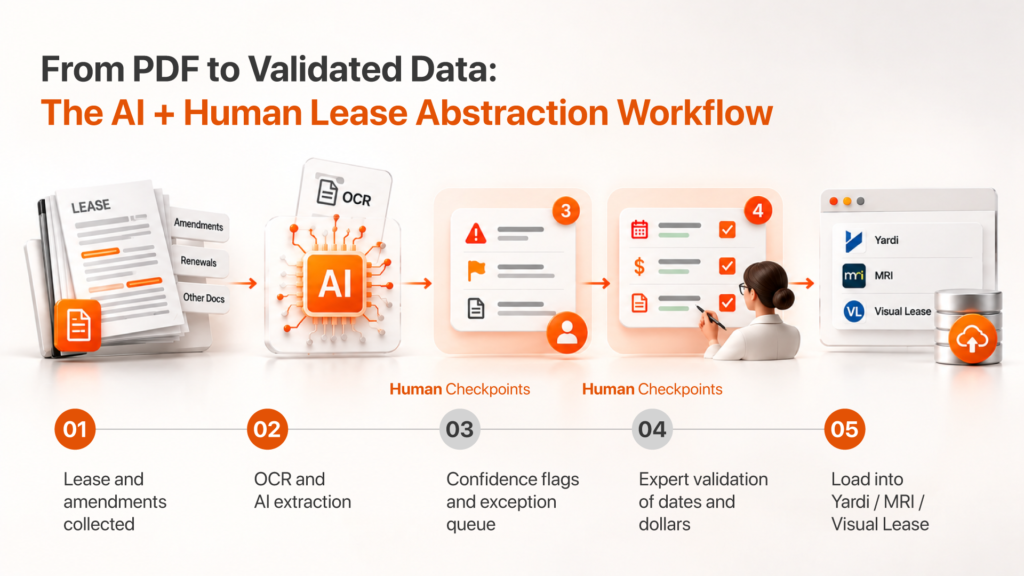
AI-powered lease abstraction combines optical character recognition (OCR) with language models. The software reads a lease PDF, locates the relevant clauses, and fills fields such as commencement date, base rent, escalations, renewal options, and notice periods. Stronger platforms add source citations that link each field to its clause, plus confidence scores that flag uncertain extractions.
What comes out is a draft. A lease abstract is only valuable when the data is right, and AI output isn’t verified until someone checks it against the lease. For a refresher on what a complete commercial lease abstract should contain, see our guide to commercial lease abstract essentials. For the technology background behind automated lease abstraction, read how technology is transforming lease abstraction. This article focuses on trust and validation.
AI vs. Manual vs. Hybrid Lease Abstraction
| Factor | Manual (expert team) | AI only | Hybrid (AI + expert validation) |
|---|---|---|---|
| Turnaround | 4 to 8 hours per English lease; about 10 working days for 50 leases | Minutes per lease for a first draft | Draft in minutes, plus review time |
| Cost | Higher for complex, amended, multilingual, or high-risk leases | Software subscription or per-document fees | Software cost plus review effort |
| Accuracy | High with multi-level QA | Varies by lease quality and clause complexity | Highest when critical fields are fully verified |
| Best for | Complex, multilingual, high-stakes leases | Standard leases, triage, search | Large portfolios needing speed and audit-ready data |
| Main risk | Slower, capacity-bound | Silent errors in dates, amendments, clauses | Needs a defined review workflow |
Speed and accuracy are different things. A tool that returns an abstract in minutes has saved time only if nobody has to redo the work later. A rent escalation read as 3% instead of 3.5%, or a notice window pulled from the wrong amendment, can sit unnoticed for years. Springbord’s own approach to outsourcing lease abstraction shows why many teams pair technology with specialist review rather than choosing one or the other.
Where AI Lease Abstraction Breaks Down
AI lease abstraction software can process complex lease portfolios, but performance tends to be more reliable on standardized documents. These are the situations where it most often fails:
- Amendments and side letters: The governing term may sit in a later document, and AI can extract the original lease value without applying the amendment hierarchy.
- Scanned or low-quality documents: Skewed pages, stamps, and handwritten edits reduce OCR quality, and errors compound downstream.
- Multilingual or non-English leases: Terminology, legal concepts, and document structure can vary across languages and jurisdictions. If translation is used before abstraction, the translated text should also be validated against the original lease.
- Non-standard clauses: Co-tenancy, exclusive-use rights, percentage rent, and bespoke termination options rarely follow a template.
- Tables and exhibits: Rent schedules and CAM exhibits often sit in formats that models misread.
The cost of these misses is rarely contained. Incorrect cap or exclusion fields flow straight into CAM reconciliation billing, and wrong dates break critical-date tracking. Our posts on the impact of inaccurate lease data and lease abstraction errors that corporate tenants can’t afford show how small extraction mistakes become costly disputes.
How to Measure AI Lease Abstraction Accuracy
The most reliable way to measure AI lease abstraction accuracy is to compare AI-extracted fields against a human-validated reference set from your own lease portfolio. A meaningful test should use representative leases, including amendments, scanned documents, complex clauses, and different property types, rather than relying only on clean, standardized leases.
| Metric | What it measures |
|---|---|
| Field-level accuracy | Percentage of extracted fields that match the source lease |
| Critical-field accuracy | Accuracy of dates, rent, financial terms, and other high-risk fields |
| Exception rate | Percentage of fields requiring human review |
| Amendment accuracy | Ability to identify and apply the latest governing lease terms |
| Processing time | Time required compared with manual abstraction |
Measuring accuracy is the first step in determining whether an AI lease abstraction tool is reliable enough for operational use. JLL’s 2025 Global Real Estate Technology Survey highlights the gap between AI experimentation and achieving intended business outcomes, reinforcing the need to evaluate AI not only on processing speed but also on accuracy, exception rates, and operational impact.
Once accuracy is measured, the next question is how much of the output requires human validation. That’s where a tiered validation approach becomes useful.
The 3-Tier Lease Data Validation Framework
Deloitte’s outlook also noted that fewer than half of respondents had implemented stronger controls such as challenger models, exception handling, or detective controls, and it urged firms to govern AI before scaling it. Lease data needs the same discipline.
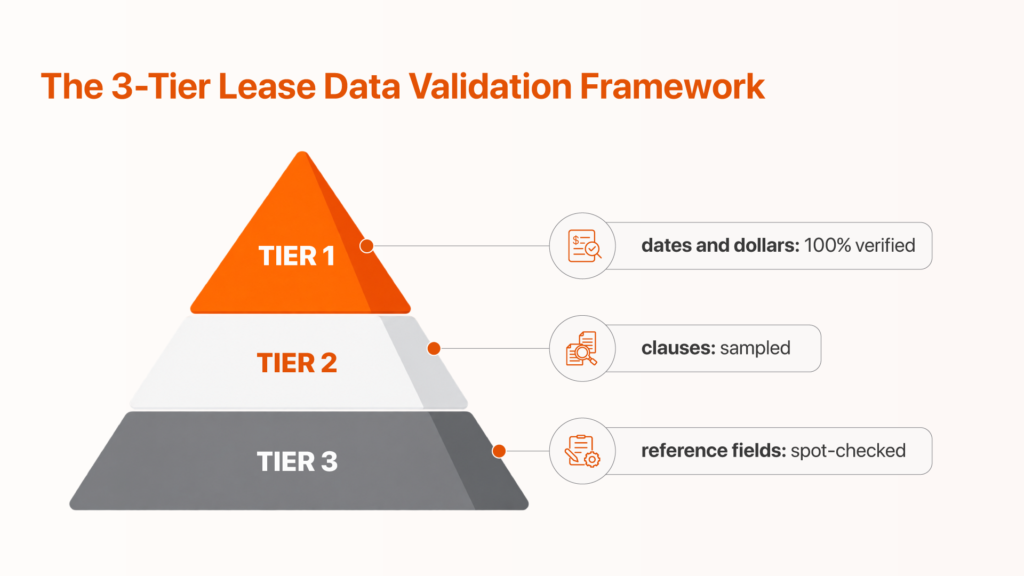
The 3-Tier Lease Data Validation Framework is a quality-control approach that assigns the highest level of human verification to fields that affect cash flow and deadlines, followed by risk-based clause review and spot checks of descriptive fields.
Tier 1: Dates and dollars (verify 100%)
A human checks every field that drives cash or deadlines against the source lease:
- Commencement, expiration, and rent commencement dates
- Renewal, termination, and notice windows
- Base rent, escalation formulas, and security deposits
- Percentage rent and recovery caps
Tier 2: Clauses and obligations (sample by risk)
Review a risk-weighted sample, and review every instance for high-value leases:
- Co-tenancy, exclusives, and radius restrictions
- Assignment, subletting, and relocation rights
- CAM exclusions, base years, and gross-up terms
- Insurance and maintenance responsibilities
Tier 3: Reference fields (spot check)
Verify a small random sample of descriptive data such as party names, suite numbers, and addresses.
Three controls make the tiers work in practice:
1. Source grounding: Every extracted value should link back to the clause and page it came from, so reviewers don’t hunt through a 90-page PDF.
2. Exception queues: Route low-confidence or conflicting fields to a reviewer instead of accepting them silently.
3. Amendment check: Confirm that every value reflects the latest amendment, not the original lease.
Run a pilot first: abstract a sample set of leases through both your AI tool and an expert reviewer, then compare Tier 1 field accuracy before you scale.
Why use a tiered approach?
Not every lease field carries the same financial or operational risk. A missed rent commencement date can affect billing immediately, while a formatting inconsistency in an address usually has a lower financial impact. A tiered review model concentrates human effort where extraction errors are most consequential while still providing quality controls for lower-risk fields.

Why AI With Human Intelligence Works Best
The hybrid approach, AI with human intelligence for lease abstraction, uses the technology for speed and people for judgment. It suits portfolios where volume is high, but errors are expensive: CRE firms and REITs protecting NOI, multi-location retailers tracking hundreds of critical dates, healthcare providers managing clinic leases, and corporate tenants with scattered lease records. See who we serve across commercial real estate, retail, and healthcare.
Springbord supports residential and commercial real estate organizations with lease abstraction, lease administration, data validation, and real estate data management. With 150,000+ leases processed, a quality control process that targets 100% accuracy on critical dates and dollar values, and ISO/IEC 27001:2022 certification, our teams work directly in 12+ lease platforms, including Yardi, MRI, Visual Lease, AppFolio, CoStar, etc. Springbord supports multilingual lease workflows with translation and abstraction followed by validation.
Whether your abstracts come from AI software, an internal team, or a previous vendor, our lease validation and lease abstraction services make sure the data you load into your system is audit-ready. Clean abstracts also feed lease administration, Yardi implementation and support, and broader data management work.
FAQ: AI Lease Abstraction & Validation
What is the difference between AI lease abstraction and AI lease review?
Lease abstraction extracts structured data fields, such as dates, rent, and options, into a database or abstract. Lease review analyzes clauses for risk, deviations from standard terms, or negotiation points. Abstraction feeds operations and reporting; review supports legal and deal decisions.
Is AI lease abstraction safe for confidential lease data?
It depends on the vendor. Before uploading leases, confirm data residency, encryption, access controls, retention/deletion policies, whether customer data is used for model training, subcontractor access, and applicable security certifications.
Can AI-extracted lease data be loaded into Yardi or MRI?
Yes, but not directly without checks. Extracted fields usually need mapping to your platform’s data structure and validation before import. Skipping that step is a common cause of migration errors and misaligned rent schedules.
How accurate is AI lease abstraction?
AI lease abstraction accuracy varies by document quality, lease complexity, amendment structure, and the AI system used. It tends to perform better on clean, standardized leases and requires human validation for critical dates, financial fields, amendments, and non-standard clauses. The most reliable way to measure accuracy is to test the tool against a representative sample of your own leases before scaling.
Will AI replace human lease abstractors?
Not for high-stakes work in the near term. AI reduces manual data entry, but reviewers still resolve amendment conflicts, interpret bespoke clauses, and certify critical data. The role is shifting from typing fields to validating them.
How do I pilot an AI lease abstraction tool?
Select 25 to 50 representative leases, including amendments, scans, and complex retail or healthcare agreements. Do not measure the pilot only by processing speed. Abstract them through the tool and through an expert reviewer, then compare Tier 1 field accuracy and exception rates before committing to a rollout.
How often should AI-extracted lease data be re-validated?
Re-validate whenever an amendment, renewal, or assignment is signed, before a system migration, and ahead of audits or acquisitions. Otherwise, run periodic sample checks to catch drift between the lease record and your system data.