

 Read time 7 min
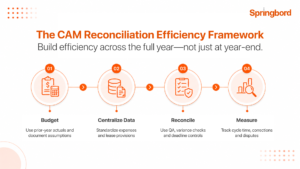
CAM reconciliation gets faster and more accurate when efficiency is built into four stages — accurate upfront budgeting, centralized data management all year, a streamlined year-end workflow, and ongoing measurement — rather than treated as a single year-end scramble.
Ask any property manager what breaks down during CAM reconciliation season, and the answer is rarely the math. It’s the twelve months leading up to it, the missed invoice codes, the scattered spreadsheets, the lease clauses nobody flagged back in March. By the time year-end arrives, an inefficient process doesn’t just cost time. It costs accuracy, and accuracy is what protects both your Net Operating Income and your tenant relationships.
Unclear CAM statements, inconsistent expense categorization, and gaps in supporting documentation can create additional review work and contribute to tenant disputes. Many commercial leases set specific deadlines for delivering annual reconciliation statements, so the reconciliation workflow needs to account for the notice and delivery requirements in each lease.
The key is to build efficiency into the process before reconciliation season begins, rather than trying to recover lost time at year-end.
This blog looks at where CAM reconciliation workflows lose time, accuracy, and the operational fixes that close those gaps, whether you manage the process in-house or lean on outsourced support.
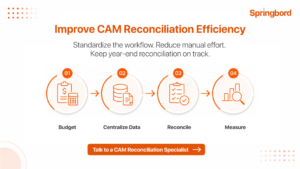
Improving CAM reconciliation efficiency comes down to four connected stages: accurate budgeting, centralized data management, a streamlined year-end workflow, and ongoing measurement. Weakness in any one stage shows up as delay or error in the next, which is why fixing them in isolation rarely works.
Why CAM Reconciliation Efficiency Breaks Down
CAM reconciliation efficiency isn’t lost in a single dramatic failure. It erodes in small, compounding ways across the year:
- Budgets built on outdated assumptions. If the initial CAM budget doesn’t reflect real vendor contracts, utility trends, or planned capital work, every monthly estimate billed to tenants is already off, and the gap only shows up at reconciliation, when it’s expensive to unwind.
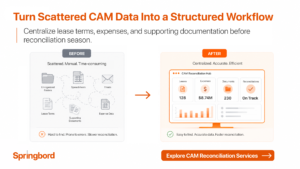
- Expense data scattered across systems. Invoices sit in one system, lease terms in another, and prior-year statements in a shared drive somebody forgot to update. When reconciliation season arrives, teams spend more time hunting for numbers than analyzing them.
- No standardized categorization. Recoverable and non-recoverable costs get coded inconsistently through the year, so by December, someone has to manually re-sort months of transactions before reconciliation can even begin.
- A single year-end crunch. When budgeting, data management, and reconciliation logic are treated as three disconnected tasks instead of one continuous process, the final stretch becomes a scramble, and that scramble produces errors.
The fix isn’t a better spreadsheet template. It’s redesigning the process so efficiency is built in at each stage, not bolted on at the end. Treating CAM reconciliation as a single year-end event rather than a twelve-month workflow with a year-end deliverable is the single biggest mistake most teams make.
Stage One: Get the Budget Right From the Start
CAM reconciliation efficiency is decided long before reconciliation happens. The estimates you set at the start of the lease year determine how large or small the year-end true-up will be, and how much explaining you’ll have to do to tenants.
An efficient budgeting process means:
- Reviewing actual prior-year expenses line by line, not just adjusting last year’s total by a flat percentage.
- Factoring in known capital projects, contract renewals, and utility rate changes before they hit the books.
- Documenting the assumptions behind each line item, so anyone reviewing the budget mid-year or auditing it later can see the logic.
BOMA International’s guidance on budgeting and accounting also emphasizes the importance of estimating operating expenses, monitoring budget variations, and maintaining cost controls, which are practices that can support a more structured CAM reconciliation process.
Getting this stage right doesn’t eliminate variance between estimated and actual costs, but it keeps that variance small and explainable, and a short quarterly check-in against the annual estimate catches drift early, while there’s still time to adjust monthly billing instead of absorbing it all at year-end.
Stage Two: Centralize Data Management Through the Year
Many CAM reconciliation delays can be traced to disorganized data and processes earlier in the year. Every recoverable operating expense like maintenance, repairs, utilities, insurance, or management fees needs to be categorized and stored in a standardized format the moment it’s incurred, not reconstructed months later from invoices and email threads.
This is also where lease-specific detail matters most. CAM provisions differ by tenant — caps, exclusions, gross-up clauses, base years — and if that lease data isn’t abstracted into a structured, searchable format, every reconciliation becomes a manual lease-reading exercise. Teams that maintain clean, centralized lease abstraction data throughout the year cut this step down dramatically, because the recoverable-expense rules for each tenant are already documented and ready to apply.
Stage Three: Make the Year-End Step Itself More Efficient
If you need a refresher on what the year-end reconciliation step actually involves — pulling actuals, applying lease terms, calculating variance, and distributing statements — our guide to where to start with CAM reconciliation walks through that process in detail. This section assumes you know the steps and focuses only on what makes them faster and less error-prone:
- Batch by lease type or property, not tenant by tenant. Grouping reconciliations by shared lease terms (same caps, same base year, same gross-up method) means the rule logic is applied once per batch instead of re-derived for every individual statement.
- Set variance thresholds that trigger automatic review. Instead of manually eyeballing every line item, flag only the expenses that land outside an expected range — this puts reviewer attention where it’s actually needed.
- Build a standing QA checklist instead of ad hoc review. A second reviewer working from a fixed checklist (categorization, lease-cap application, math) catches more errors, faster, than an unstructured read-through.
- Pre-schedule the distribution window. Treating statement distribution as a fixed date on the calendar keeps the whole team accountable to the 30- to 90-day requirement instead of discovering the deadline late.
And if you want a closer look at what a reconciliation statement itself should include once it’s ready to go out, our overview of the CAM reconciliation statement breaks down each section tenants and landlords need to see.
A pre-reconciliation readiness check also helps catch gaps before they become deadline problems. Our audit season CAM reconciliation checklist walks through what to verify before the year-end push begins.
Stage Four: Measuring Whether Your Process Is Actually More Efficient
Process efficiency is measurable. A few indicators worth tracking year over year:
- Reconciliation cycle time: how many days it takes from year-end close to statement distribution.
- Correction rate: how many statements need to be reissued or adjusted after distribution.
- Dispute rate: how many tenants formally question or challenge their CAM statement.
- Time spent per tenant statement: a rising number usually signals a data or categorization problem upstream, not a reconciliation problem itself.
|
KPI |
What it reveals |
|
Cycle time |
Process speed |
|
Correction rate |
QA/data problems |
|
Dispute rate |
Statement/lease communication issues |
|
Time per statement |
Workflow/data bottlenecks |
If these numbers are trending the wrong way, then despite process changes, it’s often a sign the bottleneck sits earlier in budgeting or data management rather than in the final calculation stage.
When Outsourced Support Fits Into an Efficient Process
Some property management teams redesign this workflow in-house. Others reach a point where portfolio size or team bandwidth makes it more practical to bring in a specialized partner for part or all of the process. Particularly for data standardization and lease abstraction, dedicated tools and experience compound efficiency gains quickly. If you’re weighing that option, our article on how outsourcing CAM reconciliation can benefit real estate businesses walks through what that support typically covers and where it delivers the most value.
Springbord works with U.S commercial real estate owners, property managers, REITs, and asset managers to keep CAM reconciliation accurate and on schedule, backed by 10+ years of CAM reconciliation experience, Six Sigma & ISO-certified process quality, and a track record across 150,000+ leases processed and hands-on expertise in 12+ real estate management platforms like Yardi, MRI, Visual Lease, and more. Whether the goal is tightening an in-house workflow or handing off the data-heavy parts of the process, the objective is the same: fewer surprises at year-end and a reconciliation statement every tenant can trust.
FAQ: CAM Reconciliation Process Efficiency
What is the biggest cause of inefficiency in CAM reconciliation? Poor data management throughout the year is the most common root cause. When expense data isn’t categorized and centralized as it’s incurred, teams lose weeks at year-end reconstructing information that should have been ready to use.
Does better budgeting actually reduce reconciliation errors? Yes. Accurate, well-documented CAM budgets keep the gap between estimated and actual expenses small, which means less complex — and less error-prone — year-end adjustments.
What role does lease abstraction play in CAM reconciliation efficiency? Lease abstraction turns caps, exclusions, gross-up clauses, and base-year terms into structured, searchable data. Without it, every reconciliation requires manually re-reading lease language, which slows the process and increases the risk of missed clauses.
How can I tell if my CAM reconciliation process is inefficient? Track cycle time, correction rate, and tenant dispute rate over multiple reconciliation cycles. Rising numbers in any of these areas usually point to a specific stage — budgeting, data management, or the year-end workflow itself — that needs attention.
Is outsourcing CAM reconciliation the only way to improve efficiency? No. Many of the efficiency gains described here, like better budgeting discipline, centralized data, and a standardized workflow, can be built in-house. Outsourcing is one option for teams that want specialized tools and experience applied to part or all of the process, particularly at scale.
Should I reconcile CAM charges quarterly instead of annually?
Most leases specify annual reconciliation, but a lighter internal quarterly review against budget can flag variance early, before it compounds into the year-end statement.