

 Read time 9 min
Managing commercial properties involves much more than keeping buildings operational. Property managers also have to coordinate tenant billing, lease requirements, operating expenses, owner reporting, vendor relationships, and financial deadlines.
As the number of properties and tenants grows, CAM reconciliation can become a recurring workload that competes with these responsibilities. The pressure can become particularly noticeable at year-end, when actual operating expenses need to be reviewed against tenant recoveries and supporting documentation needs to be finalized.
For US commercial property managers, outsourcing is therefore less about simply transferring a task to an outside provider and more about managing portfolio workload, staff capacity, tenant billing, reporting, and operational controls.
A specialized CAM reconciliation service can provide additional processing capacity while allowing property management teams to retain oversight of approvals, exceptions, tenant relationships, and owner communication.
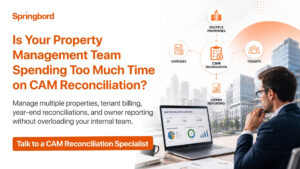
Why CAM Reconciliation Becomes a Capacity Issue for Property Managers
CAM reconciliation requires property managers to bring together property expenses, tenant lease provisions, allocation rules, billing information, and actual versus projected costs.
The process becomes more demanding when a portfolio contains multiple buildings and tenants with different lease structures. IREM’s guidance on CAM reconciliation notes that property managers reconcile estimated CAM charges against actual costs and must account for lease-specific expense inclusions, exclusions, caps, and allocation methods.
The challenge for property managers is that these activities do not happen in isolation. They sit alongside the team’s daily operational responsibilities.
A growing portfolio can therefore create a capacity gap:
More properties → more tenants → more expense data → more lease-specific reviews → more billing and reporting work.
When the internal team has to absorb all of this work, reconciliation can become a bottleneck rather than a routine financial process.
6 Property Management Pressures That Signal a Need for Additional CAM Support
1. A Growing Portfolio Is Increasing Reconciliation Workload
Managing CAM reconciliation for one property is different from coordinating it across a portfolio.
Each property can have its own:
- Tenant mix
- Lease provisions
- Recoverable expense categories
- Allocation methodology
- Operating expenses
- Billing schedules
- Supporting documentation
- Reporting requirements
Property managers overseeing multiple properties may therefore need to coordinate several reconciliation workflows simultaneously.
Standardization becomes increasingly important as the portfolio grows. BOMA’s current standards also recognize the need to support different commercial property configurations, including single-tenant, multi-tenant, and multi-building properties.
Outsourcing can provide additional processing capacity when portfolio growth begins to outpace the internal team’s ability to manage reconciliation efficiently.
2. Property Management Staff Are Spending Too Much Time on Repetitive Work
Property managers are responsible for a wide range of operational and financial activities.
Their responsibilities may include:
- Tenant communication
- Lease administration
- Vendor coordination
- Maintenance oversight
- Budget management
- Property inspections
- Owner communication
- Financial reporting
- Expense management
When staff members also spend substantial time collecting expense data, checking tenant allocations, preparing reconciliation calculations, and resolving discrepancies, less time remains for property-level responsibilities.
The issue is not necessarily that the work is too complex for an internal team. It may simply be consuming too much of the team’s available capacity.
Outsourcing can help separate repetitive reconciliation activities from the property manager’s higher-priority operational responsibilities.
3. Tenant Billing Requires Extensive Manual Review
Tenant billing can become particularly demanding when leases contain different expense recovery provisions.
Property managers may need to compare actual expenses with estimates, verify tenant allocations, review adjustments, and identify underpayments or overpayments before final billing.
Lease provisions determine how operating expenses are allocated, which means the same approach cannot necessarily be applied to every tenant. BOMA International notes that leases can contain detailed provisions determining which operating expenses can be passed through to tenants and what exclusions or limitations apply.
For property managers, this makes documentation and lease-level review important parts of the billing workflow.
An outsourced team can support the processing and review work while the property manager retains responsibility for approvals and tenant-facing decisions.
4. Year-End CAM Reconciliation Creates a Recurring Workload Spike
Year-end can bring several reconciliation-related tasks together.
Property managers may need to manage:
- Actual operating expenses
- Tenant recovery calculations
- Expense allocations
- Reconciliation adjustments
- Supporting documentation
- Tenant statements
- Owner reporting
- Internal reviews
- Discrepancy resolution
If the same employees are responsible for other year-end accounting and property-management activities, reconciliation can quickly become a bottleneck.
IREM explains that property managers reconcile actual shared expenses against projected costs and notes that lease-specific deadlines can affect how reconciliation should be handled.
This makes year-end capacity planning important.
Outsourcing can provide additional support during periods when reconciliation workload temporarily increases without requiring the property management company to expand its internal staff permanently.
5. Reconciliation Delays Are Affecting Owner Reporting
Property owners rely on timely financial information to understand property performance and operating results.
When reconciliation work is delayed, related reporting can also be delayed or require additional manual adjustments.
A consistent reconciliation process can make it easier to organize:
- Tenant recoveries
- Operating expenses
- Reconciliation adjustments
- Variances
- Supporting documentation
- Property-level financial information
BOMA’s property-management guidance connects financial reporting with operating statements, variance reports, aged receivables, rent rolls, capital expenditure reports, and other financial records used in ownership reporting.
For property managers, maintaining a structured reconciliation workflow can therefore support more reliable downstream reporting.
6. Operational Controls Are Becoming Difficult to Maintain
As portfolios grow, informal processes can become harder to manage.
A reconciliation workflow that depends heavily on individual employees, disconnected spreadsheets, or undocumented adjustments can make it difficult to answer basic control questions:
- Who reviewed the calculation?
- What supporting documentation was used?
- Why was an adjustment made?
- Which lease provision was applied?
- Has the final amount been approved?
- Can the calculation be traced back to the underlying expense?
Outsourcing can support a more standardized workflow with defined review points, documentation requirements, exception tracking, and approval responsibilities.
The goal is not to remove the property manager from the process. It is to make the process easier to manage and monitor.
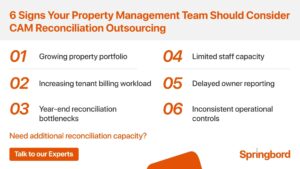
When Should Property Managers Consider Outsourcing CAM Reconciliation?
There is no single portfolio size or workload threshold at which outsourcing becomes necessary.
Instead, property managers should look at the operational signals within their existing process.
Outsourcing may be worth evaluating when:
Portfolio growth is outpacing staff capacity
If properties and tenants are being added without corresponding increases in internal resources, reconciliation workload can become increasingly difficult to absorb.
Year-end repeatedly creates bottlenecks
If reconciliation work consistently competes with other year-end responsibilities, additional processing capacity may help the team manage deadlines more effectively.
Manual spreadsheets dominate the workflow
Heavy spreadsheet dependency can increase the amount of time staff spend gathering, checking, updating, and reconciling information.
Tenant billing requires repeated corrections
Frequent billing adjustments or disputes can indicate that the underlying reconciliation workflow needs additional review and control.
Owner reporting depends on delayed reconciliation
If owners have to wait for reconciliation information before receiving complete financial reporting, the issue extends beyond accounting workload.
Skilled employees are performing repetitive reconciliation tasks
When property-management professionals spend substantial time on repetitive processing, outsourcing can allow them to focus more on tenant relationships, property operations, and owner priorities.
How Outsourcing Fits Into a Property Manager’s Existing Workflow
Outsourcing does not have to mean transferring complete responsibility for the process.
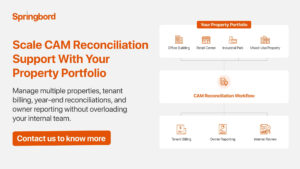
A property management company can establish a workflow in which the outsourced team supports defined processing activities while internal staff retain control over approvals and business decisions.
A typical workflow can include:
- Property and lease information is provided to the external team.
- Expense data and supporting documentation are reviewed.
- Tenant allocations and reconciliation calculations are prepared.
- Exceptions and discrepancies are identified.
- Property management staff review required exceptions and approvals.
- Final reconciliation information is prepared for billing and reporting.
- Supporting documentation is organized for future reference.
This division of responsibilities allows property managers to retain operational control without requiring internal staff to perform every processing activity.
For a detailed explanation of the underlying workflow, property managers can refer to the CAM reconciliation process guide.
What Property Managers Can Keep In-House
Outsourcing reconciliation support does not mean property managers should hand over every decision.
Internal teams can continue to manage:
- Final approvals
- Tenant relationships
- Owner communication
- Lease interpretation and business decisions
- Exception resolution
- Property-level decisions
- Service-provider oversight
- Internal financial controls
The external team can support the repetitive and time-intensive portions of the workflow while the property manager remains responsible for decisions that require property-specific knowledge.
This distinction is important because outsourcing should strengthen the property-management workflow rather than create another layer of operational complexity.
How Outsourcing Supports Multi-Property Property Management Teams
The value of outsourcing becomes more apparent when reconciliation must be coordinated across multiple properties.
Instead of each property following a completely different workflow, the property management company can establish common procedures for:
- Data collection
- Expense review
- Tenant allocation
- Exception handling
- Documentation
- Quality checks
- Reporting
- Approval
Standardization can make it easier to identify where a property deviates from the expected process.
It can also make onboarding easier when new employees or properties are added to the portfolio.
BOMA’s commercial-property standards recognize that measurement and allocation considerations can vary by property type and configuration, reinforcing why portfolio-wide processes need appropriate property-level controls rather than a one-size-fits-all calculation.
Common Warning Signs in a CAM Reconciliation Workflow
Before deciding whether to outsource, property managers should examine the current process for recurring problems.
Some warning signs include:
Incomplete supporting data
Missing invoices, expense records, tenant information, or lease details can delay reconciliation and increase manual follow-up.
Lease discrepancies
Different lease provisions can create problems when the wrong recovery rule, allocation method, or exclusion is applied.
Repeated tenant billing corrections
Frequent adjustments after tenant statements have been issued may indicate weaknesses in the review process.
Manual spreadsheet dependency
Spreadsheets can be useful, but a process that depends on numerous disconnected files can make version control and audit trails more difficult.
Missed or compressed deadlines
Lease-specific deadlines can create additional pressure when reconciliation work begins late.
Staff capacity constraints
If the same employees repeatedly struggle to complete reconciliation alongside their other property-management responsibilities, the issue may be capacity rather than technical expertise.
For a deeper look at these issues, see common CAM reconciliation challenges.
How Outsourcing Supports Property Management Operations
Outsourcing can provide several operational benefits, but the value depends on how the service is structured and integrated with the property management team’s workflow.
For property managers, the most relevant benefits can include:
Additional processing capacity
External support can help absorb reconciliation work when the internal team is managing a large portfolio or seasonal workload.
More consistent workflows
A standardized external process can help establish consistent procedures for data review, calculations, documentation, and exception handling.
Better allocation of internal staff time
Property management employees can spend less time on repetitive reconciliation tasks and more time on tenant, owner, and property-management responsibilities.
Support during year-end peaks
External capacity can be particularly useful when reconciliation workload increases around annual expense reviews and tenant billing.
Structured documentation
Defined workflows can make it easier to maintain supporting information and track exceptions and adjustments.
These benefits are specific to the property-management use case. For the broader business case covering cost, expertise, scalability, and operational efficiency, see CAM reconciliation outsourcing benefits.
What to Review Before Outsourcing CAM Reconciliation
Choosing an outsourcing partner involves more than comparing costs. Property managers should assess the provider’s CRE experience, capacity, quality controls, data security, and ability to work within existing workflows.
Commercial Real Estate Experience
Look for a provider that understands leases, operating expenses, tenant recoveries, property-level reporting, and commercial real estate workflows.
With 10+ years of CRE experience and a 500+ resource pool, Springbord supports commercial real estate processes and CAM-related workflows.
Portfolio-Scale Capacity
The provider should be able to handle multiple properties and increased workloads during periods such as year-end reconciliation.
Springbord has handled 5,000+ projects and processed 50M+ data points, providing evidence of experience managing high-volume business processes. Learn why Springbord.
Quality and Process Controls
Ask how calculations, exceptions, documentation, and adjustments are reviewed before final outputs are delivered.
Springbord’s Six Sigma-certified teams and ISO/IEC 9001 certification support its focus on process quality and consistency.
Data Security
Because CAM reconciliation involves lease, tenant, financial, and property information, data-security practices should be a key selection criterion.
Springbord is ISO/IEC 27001:2022 certified for its Information Security Management System (ISMS), providing an established framework for information-security management.
Workflow and Technology Compatibility
An outsourcing partner should be able to work with the systems and processes already used by the property management team.
Springbord’s real estate teams work with platforms including Yardi, MRI, Visual Lease, and CoStar, helping integrate outsourced support into existing workflows.
A Quick Evaluation Checklist
Before selecting a provider, property managers should ask:
- Does the provider have commercial real estate experience?
- Can it support portfolio-level and peak-period workloads?
- What quality-control procedures are in place?
- How is sensitive property and tenant data protected?
- Can the team work with our existing systems and processes?
Frequently Asked Questions
Can property managers outsource CAM reconciliation for multiple properties?
Yes. Multiple properties can increase the number of tenants, expenses, lease requirements, calculations, and reporting tasks that need to be coordinated. Outsourcing can provide additional processing capacity while helping standardize the workflow across the portfolio.
Can outsourcing help property managers handle year-end CAM reconciliation?
Yes. External support can provide additional capacity when actual operating expenses, tenant recoveries, reconciliation adjustments, supporting documentation, and reporting create a year-end workload spike.
Does outsourcing CAM reconciliation mean property managers lose control?
No. Property managers can retain responsibility for approvals, exceptions, tenant relationships, owner communication, and property-level decisions while an external team handles agreed-upon processing and support activities.
How can outsourced CAM support tenant billing?
An outsourced workflow can help organize expense information, review tenant allocations, identify discrepancies, and prepare reconciliation information according to the agreed process before final billing is approved.
Can outsourced reconciliation support owner reporting?
Yes. A structured reconciliation workflow can help organize tenant recovery, expense, adjustment, and supporting information so property managers can use it in their owner-reporting processes.
What should property managers review before outsourcing CAM reconciliation?
Property managers should review the provider’s commercial real estate experience, multi-property capabilities, quality-control procedures, data-security practices, communication model, reporting process, and ability to work within existing systems and approval workflows.