
 Read time 9 min
✓
✓
✓
✓
✓
✓
Common area maintenance (CAM) reconciliation is how landlords true up what tenants were billed in estimated monthly charges against actual shared-area expenses for the year. This article focuses on what landlords specifically need to get right, which lease types require reconciliation, how to calculate gross-ups and caps correctly, and what to build into a reconciliation template, rather than the mechanics of the reconciliation process itself. For the step-by-step walkthrough of the CAM reconciliation process, see our guide to the CAM reconciliation process.
For commercial landlords, CAM reconciliation accuracy depends on getting three things right: understanding how the lease allocates CAM expenses, calculating gross-ups and pro-rata shares correctly, and applying expense caps and exclusions exactly as negotiated. Getting any of these wrong either underrecovers costs or invites tenant disputes.
What CAM Expenses Typically Cover
Common area maintenance expenses generally cover costs associated with maintaining and operating shared areas of a commercial property, such as janitorial services, landscaping, snow and debris removal, parking lot repairs, common-area utilities, security, and routine preventive maintenance. Not every property or lease includes the same scope. Coverage varies by property type, location, and building age, which is exactly why the lease language defining CAM charges matters more than any general definition of it.
CAM reconciliation disputes most often arise when lease language is ambiguous, CAM expenses are incorrectly classified, CAM charge allocations are unclear, caps & gross-ups are miscalculated, or supporting documentation is incomplete.
A generic, broad CAM definition in the lease gives the landlord flexibility to include a wide range of costs, but it also invites more scrutiny at reconciliation time, since tenants are more likely to question a charge if the lease language doesn’t clearly explain why it qualifies. A more specific, itemized CAM definition takes more work to negotiate upfront, but tends to produce fewer disputes down the line. Every dollar billed can be traced back to a category the tenant already agreed to.
3 Key Areas Commercial Landlords Should Get Right in CAM Reconciliation
Commercial landlords need to pay close attention to three areas when reviewing and performing CAM reconciliation: how the lease structure determines expense recovery, how recoverable expenses are calculated and allocated, and how fee caps limit certain recoveries. Getting these elements right helps landlords apply lease terms consistently and avoid unnecessary recovery gaps or billing disputes.
1. How Lease Structure Affects CAM Reconciliation
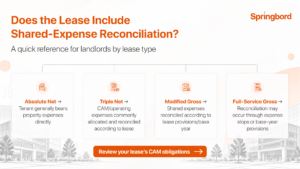
Not every commercial lease structure involves CAM reconciliation. Under an absolute net lease, the tenant generally assumes responsibility for property expenses directly, so there may be little or no landlord-performed CAM reconciliation. Triple net and modified gross leases commonly include mechanisms for allocating and reconciling shared operating expenses, although the specific lease language determines how the reconciliation works. Interior maintenance and tenant-specific repairs also generally fall outside CAM. Those are billable directly to the responsible tenant, not pooled into the shared reconciliation. Capital expenditures are often excluded from CAM, although a lease may allow certain capital costs to be recovered when they meet specified conditions, such as being amortized over a defined period or producing operating-cost savings. Since the applicable rules shift by lease structure, our guide to CAM reconciliation across different lease types covers each scenario in more depth.
2. Calculating CAM Reconciliation the Right Way
An accurate CAM reconciliation calculation depends on a consistent set of inputs applied the same way every year: each tenant’s pro-rata share of the property, gross-up adjustments for occupancy, any negotiated expense caps or exclusions, and how capital improvements are treated.
The pro-rata share is usually a tenant’s leasable square footage divided by the building’s total leasable area, but it becomes complicated when vacancies exist. That’s where gross-ups come in. Where the lease permits a gross-up, landlords may adjust certain variable operating expenses to a specified occupancy level so that recoverable costs are allocated consistently despite vacancies. The applicable gross-up percentage, expense categories, and methodology should follow the lease language. An incorrect gross-up can have a significant impact because the calculation may affect multiple tenants, not just a single bill.
Landlords should also build in a second review step before statements go out: a single miscategorized expense, multiplied across a full rent roll, can turn a minor error into a material recovery gap. This is also where good documentation habits pay off: an expense that can be traced back to an invoice and a lease clause is far easier to defend than one a tenant has to take on faith.
3. Setting Fee Caps Landlords Should Get Right
Lease negotiations increasingly include a controllable expense cap limiting how much a tenant’s share of CAM can rise year over year. Caps are often negotiated as a percentage limit on year-over-year increases in specified controllable expenses, with the actual percentage varying by market, property, tenant, and lease negotiations. For example, a lease might establish a 3% or 5% annual cap on specified controllable expenses, and it can be structured as either cumulative or non-cumulative. Under a cumulative cap, the lease may allow unused cap capacity to carry forward into later years; under a non-cumulative cap, each year’s limit stands independent.
A cumulative structure can be more favorable to landlords because it may provide greater recovery flexibility when eligible expenses increase sharply in a later year. Tenants may prefer non-cumulative caps because they provide a more predictable annual limit.
Landlords who agree to a cap without clear, limiting language in the lease risk being unable to recover legitimate cost increases later. The lease should also clearly distinguish recoverable operating expenses from non-recoverable costs (including any capital, administrative, or other excluded expenses), since ambiguity here is one of the most common sources of tenant disputes at reconciliation time. According to BOMA International’s resource about how leases govern CAM, commercial leases commonly define which operating expenses can be passed through to tenants on a pro-rata basis, while capital expenses are often subject to specific limitations or negotiated exceptions. This reinforces the importance of reviewing the lease language before classifying an expense as recoverable. For the fuller legal picture, see our guide to legal considerations in CAM reconciliation.

How CAM Reconciliation Accuracy Protects NOI
Under-recovered CAM expenses mean the property absorbs costs it was entitled to bill tenants for, which is a direct hit to Net Operating Income. Read our detailed guide to learn more about how CAM reconciliation affects NOI. Over-recovery creates a different problem: disputes, tenant pushback, and reputational cost that can outweigh the extra dollars collected. Disputes take time and legal attention to resolve, which is its own hidden cost. For landlords, the goal isn’t maximizing what’s billed but accurately recovering what the lease actually entitles you to, consistently, year after year, in a way that holds up if a tenant exercises their audit rights.
What to Include in a CAM Reconciliation Template
A CAM reconciliation statement should typically include:
- total recoverable operating expenses by category
- each tenant’s pro-rata share and square footage
- estimated payments collected during the year
- the calculated true-up (owed or credited)
- any applicable caps or exclusions applied
- supporting documentation references for each expense line.
If you want to see how these elements come together in a finished document, our overview of the CAM reconciliation statement walks through this section by section.
It’s worth building a template so a tenant’s finance team or their auditor, if they exercise audit rights, can follow the calculation without needing to ask for clarification. A statement that simply states a final number invites more questions than one that shows the math: starting expense total, pro-rata percentage, gross-up adjustment if any, cap applied if any, and the resulting reimbursement or credit. Landlords who standardize the statement’s template across every property make it far easier to spot inconsistencies, respond to tenant questions quickly, and hand off clean, defensible records during a sale or refinance.
Here is a CAM reconciliation template checklist for commercial landlords
☐ Property and reconciliation period
☐ Recoverable expenses by category
☐ Tenant rentable/occupied area
☐ Pro-rata allocation
☐ Gross-up adjustment, if applicable
☐ Caps and exclusions
☐ Estimated CAM collected
☐ Final amount due or credit
☐ Supporting invoices/documentation
Landlord vs. Investor Perspective on CAM Reconciliation
Landlords and investors use CAM reconciliation for different decisions. Landlords focus on accurate lease-based recovery, tenant billing, and dispute prevention at the property level. Investors, particularly those managing portfolios or evaluating acquisitions, are more focused on how reconciliation accuracy rolls up into NOI and asset value across multiple properties. If you’re evaluating CAM from an investor perspective, our guide to CAM reconciliation for real estate investors covers reimbursement calculations, portfolio oversight, and acquisition diligence in more detail.
When Landlords Should Consider Outsourcing CAM Reconciliation
Outsourcing tends to make the most sense when a landlord manages multiple properties with inconsistent reconciliation practices, when gross-up and cap calculations need a documented, repeatable methodology, or when internal teams don’t have the bandwidth to get statements out within the lease-required window. It’s also worth considering when a portfolio has grown through acquisition. Newly acquired properties often arrive with their own reconciliation habits and expense-coding conventions, and standardizing them onto one consistent methodology is exactly the kind of work a specialized partner can absorb quickly.
Springbord supports commercial landlords with CAM reconciliation services built around accurate gross-ups, consistent cap application, and audit-ready documentation, backed by over a decade of real estate accounting experience, ISO-certified process quality, and a track record of 60K+ CAM reconciliations handled.

Our article on the benefits of outsourcing CAM reconciliation covers what the outsourced support typically includes.
FAQ: CAM Reconciliation for Commercial Landlords
Can tenants audit or dispute a landlord’s CAM reconciliation?
Many commercial leases provide tenants with audit or review rights, but the scope, notice requirements, documentation rights, and deadlines depend on the lease. Landlords should review the applicable audit clause and maintain organized, invoice-backed records to support the reconciliation.
How long should landlords keep CAM reconciliation records?
There is no universal retention period for CAM reconciliation records. Landlords should retain reconciliation statements, supporting invoices, allocation calculations, gross-up schedules, lease documents, and related correspondence for the period required by the lease, applicable legal and tax requirements, and the landlord’s record-retention policy.
How does CAM reconciliation differ across office, retail, and industrial properties?
Retail properties often include more common-area services, like mall corridors and shared parking. Industrial properties tend to have simpler CAM pools. Office buildings frequently split CAM by floor or shared amenity use. Lease language, not property type alone, ultimately determines what’s recoverable.
What’s included in professional CAM reconciliation services for landlords?
Professional CAM reconciliation services may include
- gross-up calculations,
- pro-rata share verification,
- cap and exclusion application,
- a standardized reconciliation template applied across every property,
- documentation prepared to withstand a tenant audit, and
- quality review
Are CAM caps required by law in commercial leases?
CAM caps are generally a negotiated contractual term rather than a universal requirement in commercial leases. Whether a cap applies, which expenses it covers, and how it operates depend on the lease and what’s negotiated between landlord & tenant, not any statutory rule.
How can landlords reduce CAM reconciliation disputes with tenants?
Provide an itemized reconciliation showing the expense categories, tenant allocation, applicable caps or exclusions, adjustments, and final amount due or credited. Providing supporting documentation and addressing material variances proactively can also reduce avoidable questions and disputes.
What is a gross-up in CAM reconciliation?
A CAM gross-up adjusts certain eligible operating expenses to a specified occupancy level when permitted by the lease. It is intended to allocate recoverable expenses consistently when a property is not fully occupied, but the applicable expenses, occupancy level, and calculation method must follow the lease.
How do CAM caps affect landlord reimbursements?
A CAM cap limits the amount by which specified recoverable expenses can increase for a tenant, subject to the lease terms. The impact depends on whether the cap is cumulative or non-cumulative, which expenses are subject to it, and whether the lease treats controllable and uncontrollable costs differently.