
 Read time 7 min
✓
✓
✓
✓
✓
Introduction
Common Area Maintenance (CAM) reconciliation is the process of comparing tenants’ estimated CAM payments with the actual recoverable operating expenses for a period, then calculating any additional amount due or credit owed under the applicable lease terms.
CAM reconciliation looks simple on paper: compare estimated charges with actuals, then bill or credit each tenant. In practice, it pulls together general ledger data, lease clauses, tenant ledgers, and a hard year-end deadline. When any one of those inputs is weak, the result is under-recovered CAM expenses, tenant disputes, or both.
This guide covers the eight common CAM problems we see most often in US commercial real estate portfolios, and how to solve each one. If you need the step-by-step method first, start with our guide on how to perform a CAM reconciliation.
8 CAM Reconciliation Challenges: A Data, Lease, Billing and Capacity Framework
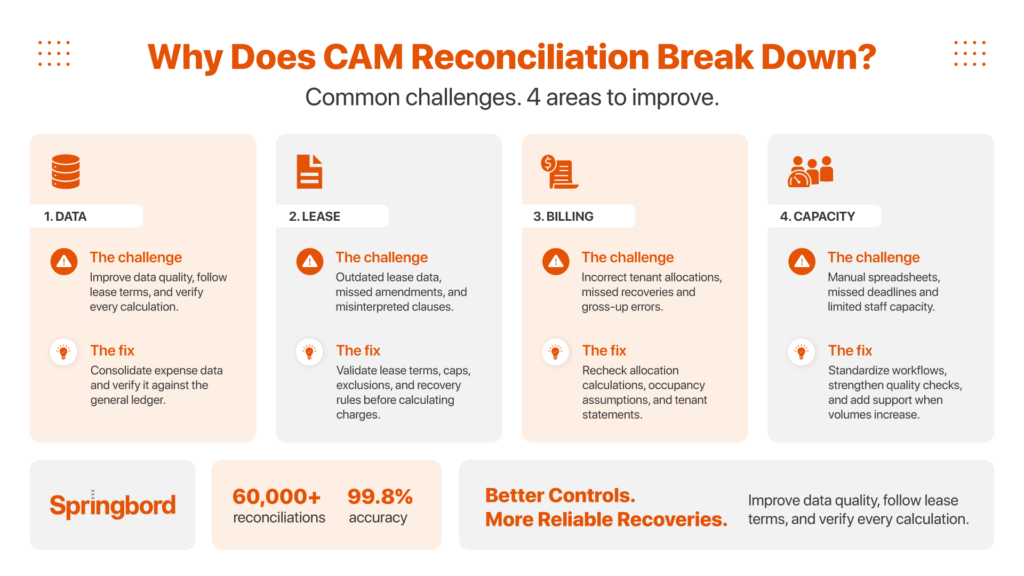
The 8 reconciliation problems can be grouped into four layers, which makes it easier to find the root cause:
- Data layer: incomplete data and manual spreadsheets.
- Lease layer: lease discrepancies, incorrect recoveries and gross-up errors.
- Billing layer: tenant billing issues.
- Capacity layer: deadlines and staff capacity.
Incomplete expense records can lead to inaccurate allocations, while outdated lease information or misinterpreted clauses can result in incorrect recoveries. Even when the underlying data is accurate, manual workflows and limited staffing can cause calculation errors, delays, and inconsistent reviews. These issues can affect the recoveries a landlord collects, the accuracy of tenant statements, and the reliability of property-level financial reporting. The following framework groups the challenges by their root causes and highlights where property teams can focus their efforts to improve accuracy and control. Need expert support with CAM reconciliation? Explore Springbord’s CAM reconciliation services.
1. Incomplete or Scattered Expense Data
The problem: Invoices sit in accounts payable, shared drives and email. GL codes are inconsistent, late invoices arrive after year-end, and capital items get mixed with operating expenses. A missed vendor invoice means a missed recoverable cost. A non-recoverable cost included by mistake invites a dispute.
The fix: Tag every expense as recoverable, non-recoverable or capital when it is posted, not at year-end. Run a monthly GL-to-CAM-pool check, and keep a standard year-end document checklist covering invoices, tax bills, insurance, CPI indices and prior-year statements. Strong upstream bookkeeping makes this far easier, which is where our real estate accounting services help.
2. Lease Discrepancies
The problem: Many teams reconcile from old abstracts or templates, but amendments, side letters, and renewals change caps, exclusions, base years, admin fees, and pro-rata shares. The calculation can be perfect and still wrong, because it was built on the wrong clause.
The fix: Validate each lease’s CAM terms against executed documents and amendments before calculating. Maintain a CAM-specific abstract per lease covering cap type, base year, exclusions, admin fee, gross-up clause and audit rights. Accurate lease abstraction services give reconciliation teams one trusted source.
3. Tenant Billing Issues
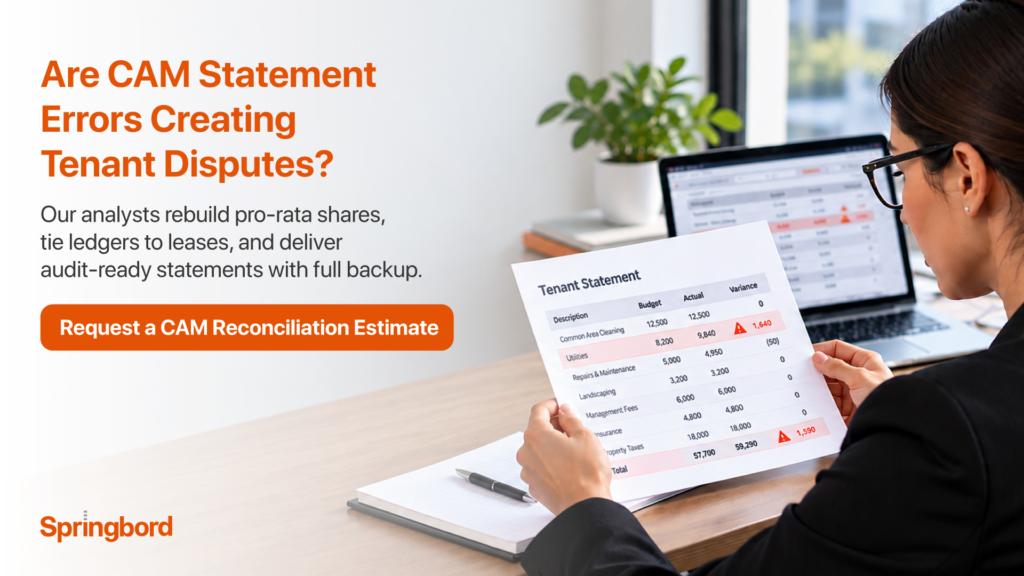
The problem: Pro-rata shares go stale after remeasurement or suite changes. Mid-year move-ins and move-outs are not prorated. Monthly estimates are not updated after a budget change. Statements arrive without backup, so tenants question them and pay late.
The fix: Reconcile the tenant ledger to current square footage and occupancy dates, then run a variance review that flags any tenant whose true-up exceeds a set threshold before statements go out. Send line-item statements with supporting detail, following a proper structure. Clear documentation is also the best defense in landlord-tenant disputes over CAM charges.
4. Incorrect Recoveries
The problem: Errors run both ways. Under-recovery happens when eligible costs are excluded, admin fees are missed, or caps are misapplied. Over-recovery happens when non-recoverable items or capital expenditures are billed, or a cap is ignored. Every under-recovered dollar lowers NOI, and every over-recovered dollar is a dispute waiting to happen.
The fix: Build a recoverability matrix by lease, apply caps in the correct order (cumulative versus non-cumulative, controllable versus uncontrollable expenses), and require a second-reviewer sign-off on each statement. To see how recoveries feed property performance, read how CAM reconciliation impacts NOI.
5. Gross-Up Errors
The problem: Gross-up adjusts variable operating expenses to what they would be at a stated occupancy level, so tenants in a partly vacant building are not left covering the gap. Errors include grossing up fixed costs such as property taxes and insurance, using the wrong occupancy base, ignoring a lease that has no gross-up clause, and applying it inconsistently across tenants. As a simple illustration, if a building is 70% occupied and $200,000 of janitorial cost is fully variable, a 95% gross-up raises the pool to roughly $271,000.
The fix:
The lease must permit the pool adjustment, and the calculation should use the occupancy basis and methodology specified in that lease. Record the gross-up clause for every lease, apply it only to variable CAM costs, confirm the occupancy base each year, and keep the calculation in a locked template.
6. Manual Spreadsheets
The problem: Spreadsheets are flexible, which is also their weakness. Version sprawl, broken formulas, hard-coded overrides, and dependence on one person’s file leave no audit trail when a tenant asks how a number was reached.
The fix: Separate inputs from calculations, lock formula cells, keep a change log, and require peer review. As portfolios grow, move calculations into a lease administration or accounting platform. If you run Yardi, our Yardi implementation and support services can help configure CAM workflows. For more ways to cut rework, see how to improve CAM reconciliation process efficiency.
7. Deadlines
The problem: Most leases set a window for delivering the annual statement, and the window varies by lease. Year-end close, audits, and budgets all land at once, so reconciliation slips to the end of the queue. Late statements can delay cash collection and, depending on the lease, weaken the landlord’s position.
The fix: Work backward from the earliest lease deadline in your portfolio. Start data collection in Q4, stage properties by complexity and tenant count, and keep a calendar of lease-specific statement dates. Do not leave the hardest properties for last.
8. Limited Staff Capacity
The problem: Reconciliation is seasonal, specialized, and often owned by one or two people. When they are stretched across other property tasks or leave, the institutional knowledge goes with them, and quality drops exactly when volume peaks.
The fix: Document your procedure, cross-train a backup, and use flexible external capacity for peak cycles, acquisitions, and audit spikes. Our guide on how outsourcing CAM reconciliation benefits real estate businesses explains when this approach pays off.
Solving These Challenges With a Specialist Team
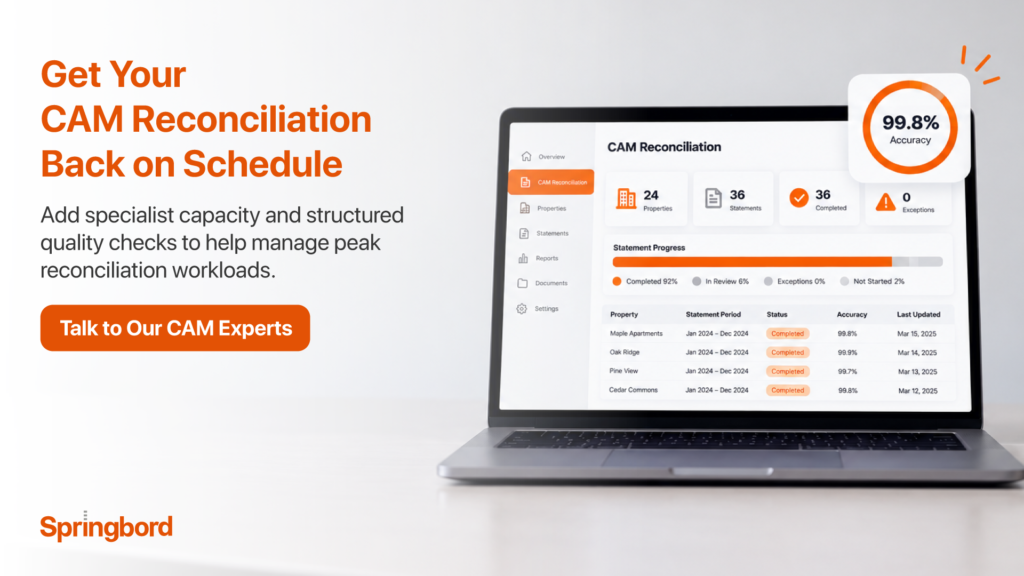
Springbord supports US landlords, property managers, asset managers, and REITs across office, retail, and commercial real estate portfolios. Our CAM reconciliation team brings 10+ years of specialized experience, Six Sigma-certified processes, ISO/IEC 27001-certified security, and a multi-level verification process that delivers 99.8% accuracy.
Based on our case study, a US property management firm struggling with inaccurate calculations and under-billing achieved 30% cost savings, 40% faster reconciliation, and 200 CAM audit reports in 45 days. Learn more about our CAM reconciliation services.
Frequently Asked Questions
What happens if a landlord makes a CAM reconciliation error?
A CAM reconciliation error can cause lost recoveries, incorrect tenant charges, disputes, or credits. Under-recovery reduces potential NOI, while over billing can trigger tenant disputes or audits. Corrections depend on the lease terms, applicable deadlines, and relevant law.
Can tenants audit reconciliation statements or dispute CAM charges?
Yes, if the lease provides audit rights or other applicable remedies. The lease typically defines the review period and procedures. Clear expense breakdowns, supporting invoices, and accurate calculations help landlords address disputes for CAM charges. Our guide to CAM audits from a landlord’s perspective shows how to prepare.
How can you catch CAM reconciliation errors before statements go out?
Review the expense pool against the general ledger, verify tenant allocations and occupancy dates, check lease caps and exclusions, validate gross-up calculations, and investigate unusual variances. A second review of high-risk items can help catch errors before statements are issued.
Can automated tools handle complex lease structures better than manual spreadsheets?
Often yes, for consistency and audit trail. Platforms such as Yardi and MRI apply caps, pro-rata shares, and gross-up rules uniformly once configured, which removes many formula and version errors. But software is only as accurate as the lease data loaded, and amendments or unusual clauses still need expert review. For mixed asset classes and varied lease terms, a platform for calculation plus an expert team for lease interpretation and exceptions works best.
Which CAM reconciliation problems are worth outsourcing: only complex properties or the whole portfolio?
Start with properties involving complex lease terms, recurring disputes, reconciliation backlogs or tight deadlines. Pilot outsourcing on selected properties and compare accuracy, turnaround time and cost before deciding whether to outsource the full portfolio.
Can an outsourced team help overcome CAM reconciliation challenges during sudden increases in workload?
Yes. An outsourced team can provide additional capacity during peak periods or acquisitions, helping manage reconciliation backlogs and meet deadlines. Clear workflows, timely access to lease documents and expense data, and defined quality checks help maintain accuracy as workloads increase.
What are the warning signs that your CAM reconciliation process has problems?
Common signs are tenants regularly disputing CAM charges, statements issued late or reissued with corrections, large unexplained true-ups, adjustments with no documentation, and results that depend on one person’s spreadsheet. Review the data, lease, billing, and capacity processes to identify and address the underlying issues.
Why do actual common area maintenance expenses often differ so much from monthly estimates?
Estimates come from a budget set before the year starts, so unplanned costs such as insurance or property tax increases, repairs, snow removal, or utility spikes make the actual CAM expenses higher. Estimates also go stale when budgets, occupancy, or square footage change mid-year. Updating estimates after major changes and reviewing them quarterly reduces large year-end true-ups.